The Government’s White Paper on levelling up will set out a complete ‘system change’ of how government works that will be implemented to level up the UK.
At the heart of this new way of making and implementing policy will be 12 bold, national missions – all quantifiable and to be achieved by 2030. These missions (in full) are the policy objectives for levelling up, and thus form the heart of the government’s agenda for the 2020s.
These missions will be cross-government, cross-society efforts. The first mission, for instance, will see pay, employment, and productivity grow everywhere, and the disparities between the top and worst performing areas narrow. This is the first time a government has placed narrowing spatial economic disparities at the heart of its agenda.
By 2030, other missions will see:
- the rest of the country’s local public transport systems becoming much closer to London standards
- the large majority of the country gain access to 5G broadband
- illiteracy and innumeracy in primary school leavers effectively eliminated – focussing the government’s education efforts on the most disadvantaged parts of the country
Research & Development (R&D)
The Research & Development (R&D) mission will see, by 2030, domestic public investment in Research & Development outside the Greater South East increase by at least 40% and at least one third over the Spending Review period, with that additional government funding seeking to leverage at least twice as much private sector investment over the long term to stimulate innovation and productivity growth.
The Challenge
Given the current spread of R&D spend, there is no doubt the Government have a levelling up challenge on their hands to achieve this R&D investment target outside of the South East.
Despite a lot of talk about levelling up over the past few years, little has changed, as evidenced below.
R&D Tax Credits
There has been a significant growth in the number and cost of R&D Tax Credit claims since 2014 – up 15% 2020 over 2019 alone – with the SME scheme accounting for 33% of the qualifying R&D expenditure (£47.5bn).
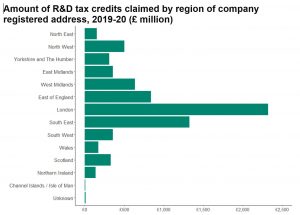
However, the distribution of R&D tax credit claims by government office region of the company’s registered address for the year ending in March 2020 shows a continuing concentration in the ‘South East’ vis:
Companies with registered offices in London (20% of total claims and 31% of total amount claimed), the South East (15% of total claims and 18% of total amount claimed). The East of England has the third largest amount claimed with 11% of the total, but is the fourth largest region based on the number of claims. The North West has the third largest number of claims, but is the fifth largest region based on the amount claimed. The proportions of claims and amount claimed by region are similar to those seen in recent years.
Amount of R&D tax credits claimed by region of company registered address, 2019-20 (£ million)
External Finance
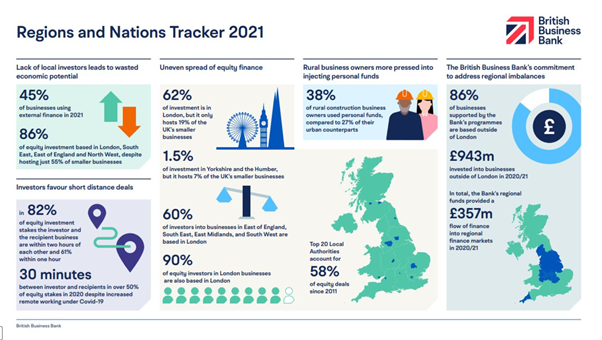
Another illustration of the current state of play is the British Business Bank’s Regions and Nations Tracker. This shows that external finance for smaller businesses is still not evenly spread across the UK, with 62% of equity investment in London, despite it only having 19% of the UK’s SME population.
The largest four regions within the UK, London, the South East, the East of England and the North West, host 55% of the business population but take in 86% of equity investment. These areas also outperform on private debt, attracting 69% of investment.
Interestingly, although London, the South East, the East of England and the North West outperform the rest of the UK in attracting important forms of growth finance, their share of high growth businesses is unremarkable. 55% of high growth businesses were in these four regions between 2018 and 2019, a share that exactly matches the proportion of the general business population to be found.
MSC R&D
It is easy to move figures around by focussing on the fewer, much larger enterprises that account for the majority of current R&D expenditure.
The challenge in levelling up is getting this increased investment to the SMEs outside of the ‘South East’ – getting more SMEs to spend more on R&D. To achieve this requires a more vertically focussed strategy, linked closely with the private funding routes, and closer to ‘home’. Encouraging startups and helping them grow in the regions is key.
Better due diligence and optimisation of R&D Tax Credit claims will both help.
One of the interesting findings from the BBB tracker was that distance matters, even in a business world that has embraced remote working.
National coverage and tech focus.
MSC R&D is a software R&D Tax Credit specialist – we operate nationally and our client base reflects this. We can support levelling up.